
Dedicated Servers
Built for High-Traffic Websites and Resource-Intensive Applications
Deploy enterprise-grade dedicated servers with dedicated CPU, memory, storage, and networking resources. Customize your infrastructure for databases, virtualization, AI, high-performance computing, and mission-critical business applications.
- 100% dedicated CPU
- No virtualization
- DDoS protection
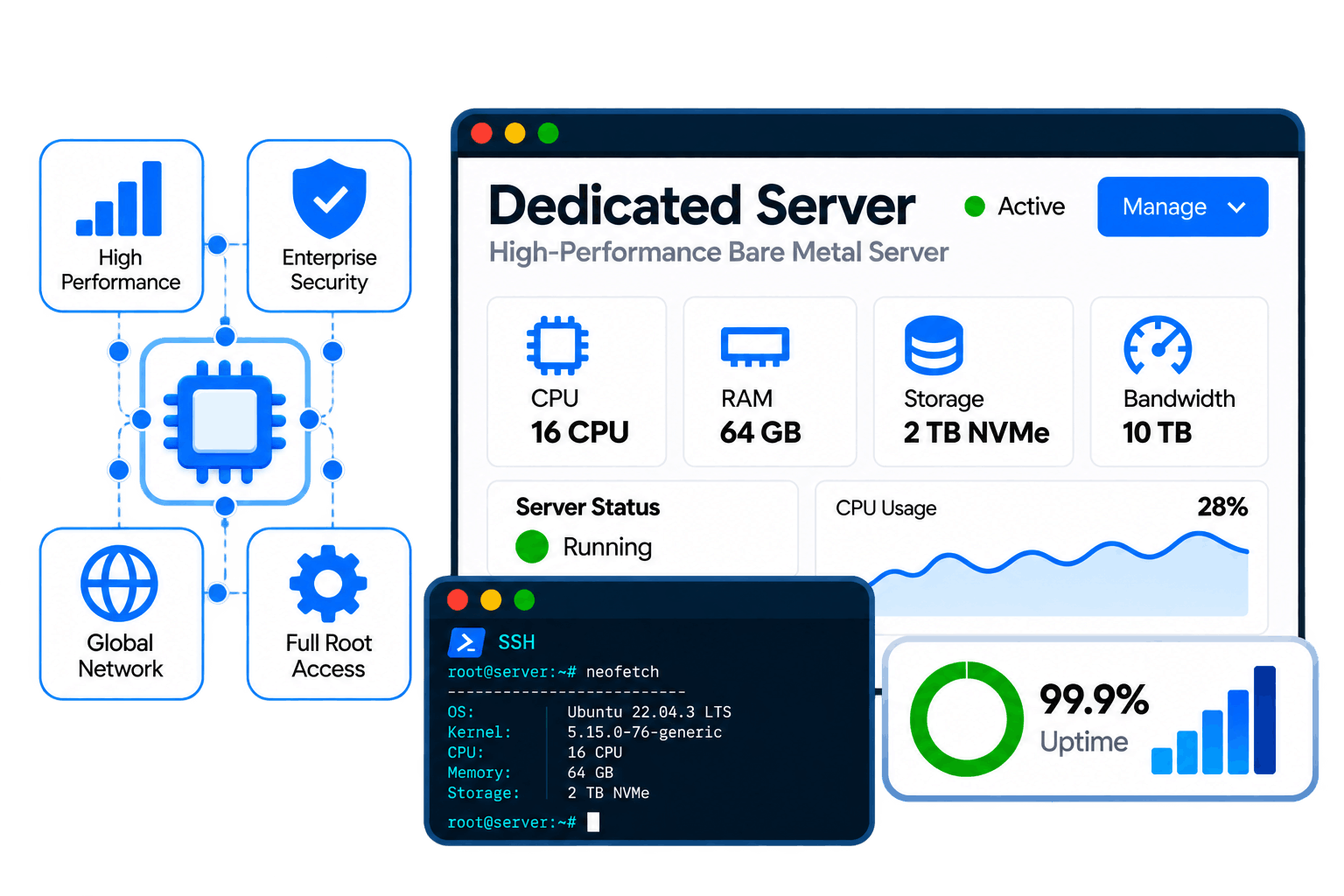
Dedicated Server Plans & Pricing in United Arab Emirates
Every plan is 100% dedicated hardware — no virtualization layer, no shared tenancy.
LBD-16.128
| vCPU | 16 CPU |
| Memory | 128 GB |
| Storage | 950 GB SSD NVMe |
| Network | 1 Gbps |
| Bandwidth | Unmetered |
| OS | Linux |
Starting from
AED789.05
/moLBD-64.728
| vCPU | 64 CPU |
| Memory | 728 GB |
| Storage | 3.84 TB SSD NVMe |
| Network | 1 Gbps |
| Bandwidth | Unmetered |
| OS | Linux |
Starting from
AED4,635.21
/moLBD-32.256
| vCPU | 32 CPU |
| Memory | 256 GB |
| Storage | 1500 GB SSD NVMe |
| Network | 1 Gbps |
| Bandwidth | Unmetered |
| OS | Linux |
Starting from
AED2,036.85
/moLBD-8.32
| vCPU | 8 CPU |
| Memory | 32 GB |
| Storage | 950 GB SSD NVMe |
| Network | 1 Gbps |
| Bandwidth | Unmetered |
| OS | Linux |
Starting from
AED642.25
/moWBD-16.128
| vCPU | 16 CPU |
| Memory | 128 GB |
| Storage | 950 GB SSD NVMe |
| Network | 1 Gbps |
| Bandwidth | Unmetered |
| OS | Linux |
Starting from
AED1,067.97
/moWBD-64.768
| vCPU | 64 CPU |
| Memory | 768 GB |
| Storage | 3.84 TB SSD NVMe |
| Network | 1 Gbps |
| Bandwidth | Unmetered |
| OS | Linux |
Starting from
AED5,842.64
/moWBD-36.512
| vCPU | 36 CPU |
| Memory | 512 GB |
| Storage | 1.90 TB SSD NVMe |
| Network | 1 Gbps |
| Bandwidth | Unmetered |
| OS | Linux |
Starting from
AED1,919.41
/moWBD-8.32
| vCPU | 8 CPU |
| Memory | 32 GB |
| Storage | 950 TB SSD NVMe |
| Network | 1 Gbps |
| Bandwidth | Unmetered |
| OS | Linux |
Starting from
AED855.11
/moWhat Is a Dedicated Server?
A dedicated server is a physical machine leased entirely to you — no hypervisor, no other tenants, no shared kernel. Everything the hardware can do is available to your workload alone.
Physical server
You're allocated an actual machine in our data center, not a slice of one.
Single tenant
No other customer's workload runs on your hardware — ever.
No virtualization overhead
Without a hypervisor layer, every CPU cycle and I/O operation goes straight to your workload.
Full hardware access
Configure RAID, BIOS settings, and low-level hardware options a VPS simply can't expose.
Dedicated server is the closest thing to owning the hardware yourself, without the capital cost or data center footprint.
Why choose Dedicated Server ?
When performance has to be predictable, removing the virtualization layer removes the variables that come with it.
Dedicated CPU
Every core is reserved for your workload, with nothing else competing for cycles.
Dedicated RAM
The full memory allocation is yours, with no hypervisor overhead reducing what's usable.
Dedicated storage
Direct access to physical drives, configured exactly to your RAID and performance needs.
Consistent performance
No variability introduced by a hypervisor scheduling cycles across multiple guests.
No noisy neighbors
Another tenant's traffic spike or runaway process simply can't exist on your server.
Hardware isolation
Complete physical separation from every other customer's infrastructure.
Dedicated Server vs. VPS
A VPS is a slice of a shared physical server. Dedicated Server is the whole machine, dedicated to you alone.
| Feature | Dedicated Server | VPS |
|---|---|---|
| Hardware | Physical | Virtual |
| CPU | Dedicated | Virtualized |
| Performance | Maximum | High |
| Isolation | Complete | Hypervisor-enforced |
| Root access | Yes | Yes |
| Custom hardware | Yes | Limited |
| Virtualization | Optional — run your own hypervisor | Built-in |
Processor options
Configure your server around the processor family that fits your workload.
Intel Xeon
Core count: 8–32 cores per socket across available Xeon Scalable models.
Enterprise workloads: databases, virtualization hosts, latency-sensitive applications.
Performance: strong single-thread performance and a mature software compatibility track record.
AMD EPYC
Core count: 6–64 cores per socket across available EPYC models.
Enterprise workloads: high-density virtualization, big data, parallelized compute.
Performance: high core counts and memory bandwidth suited to heavily threaded workloads.
Memory & storage
Mix and match memory and storage types, and choose the RAID level that fits your durability and performance needs.
Memory
Storage
RAID levels
RAID 0
Striped for maximum throughput, no redundancy.
RAID 1
Mirrored drives for straightforward redundancy.
RAID 5
Striped with parity, balancing capacity and redundancy.
RAID 10
Mirrored and striped for strong performance and redundancy.
Network & connectivity
Every server ships with a real, dedicated network port — sized to the plan and upgradable on request.
1 Gbps ports
Choose the uplink speed that matches your expected throughput.
IPv4
Dedicated IPv4 connectivity for your server, with a public IP address assigned for reliable internet access.
IPv6
Full IPv6 allocation available alongside your IPv4 addresses.
DDoS protection
Volumetric attacks are filtered upstream before reaching your server.
Private network
Connect multiple servers over an internal network, isolated from the public internet.
Public network
Direct public connectivity with generous monthly bandwidth allowances.
Supported operating systems
Deploy dedicated server with a standard OS, or install a hypervisor directly on the hardware — your call.
Linux
Ubuntu, Debian, AlmaLinux, Rocky Linux & CentOS available.
Windows
Windows Server 2019, 2022 & 2025 available.
VMware
VMware ESXi installed directly on your dedicated hardware.
Proxmox
Open-source Proxmox VE for self-managed virtualization.
Hyper-V
Microsoft's native hypervisor for Windows-centric virtualization.
Virtualization support
Dedicated server doesn't mean no virtualization — it means the choice of running it is entirely yours.
VMware ESXi
Enterprise-grade virtualization for teams already standardized on VMware.
Proxmox VE
A free, open-source alternative combining KVM and container virtualization.
Hyper-V
Microsoft's hypervisor, integrated tightly with Windows Server environments.
KVM
Install KVM directly to run your own fleet of virtual machines on the hardware.
XCP-ng
An open-source Xen-based platform for teams wanting a Citrix Hypervisor alternative.
Security
Physical isolation is the foundation — additional protections layer on top of it.
Dedicated hardware
No shared kernel or hypervisor vulnerabilities to worry about — the whole machine is yours.
Secure Boot
Verify firmware and bootloader integrity before your OS ever loads.
Firewall
Configure inbound and outbound rules at the OS or network edge.
VLAN segmentation
Separate traffic logically across your infrastructure for tighter access control.
DDoS protection
Upstream filtering absorbs volumetric attacks before they reach your server.
Private networking
Move sensitive traffic between servers off the public internet entirely.
Backup & disaster recovery
Hardware redundancy reduces risk — it doesn't replace a real backup and recovery plan.
Snapshots
Capture a point-in-time image before a risky change and roll back quickly if needed.
Offsite backup
Replicate backups to a separate location so a single site incident can't take everything down.
Backup storage
Dedicated storage capacity for scheduled backups, separate from your primary drives.
Recovery
Restore from a snapshot or backup with support guidance if a restore doesn't go as planned.
Monitoring & remote management
Out-of-band access means you can manage your server even if the OS itself won't boot.
IPMI
Standard out-of-band management for power control and console access.
iDRAC
Dell's remote management interface for supported server models.
iLO
HPE's integrated Lights-Out remote management for supported server models.
KVM over IP
Remote keyboard, video, and mouse access to your server's console over the network.
Hardware monitoring
Track temperature, disk health, and component status from your dashboard.
Alerts
Get notified automatically if hardware metrics move outside normal ranges.
Popular use cases
If a workload needs maximum, predictable performance, dedicated server is usually the right foundation.
Virtualization
Run your own ESXi, Proxmox, or Hyper-V stack without paying a virtualization tax on top of a host that's already virtualizing the box under you.
Database servers
Disk I/O goes straight to NVMe with no other tenant's queries competing for the same queue depth during peak load.
Kubernetes
Run control-plane and worker nodes on hardware you fully control — no cloud provider's hypervisor layer eating into your node capacity.
AI & machine learning
Full PCIe lane access for GPU passthrough and local NVMe, without a hypervisor throttling throughput between accelerator and storage.
Game servers
Predictable tick rates with no risk of another tenant's traffic spike causing jitter mid-match.
Video streaming
A dedicated network port sized for sustained delivery, not the bursty traffic pattern most shared VPS plans are tuned for.
Enterprise applications
Keep regulated or compliance-sensitive workloads on hardware isolated from every other customer, hosted in our Noida or Mumbai data center.
Big data
Direct NVMe throughput and high memory bandwidth for datasets too large for a hypervisor's memory ballooning to handle gracefully.
Email hosting
Full control over your mail stack and IP reputation — nothing to inherit from a noisy neighbor's spam on a shared subnet.
High-traffic websites
Absorb traffic spikes without hitting a virtualized CPU ceiling shared with other tenants on the same host.
Why Choose Qpeck for Dedicated Server Hosting
for businesses in United Arab Emirates?
We're not a reseller front for someone else's data center — here's what that actually means for you.
Dedicated Resources, Built for Performance
Get dedicated CPU, RAM and storage resources without sharing them with other customers — delivering consistent performance for websites, applications and demanding workloads.
One vendor for the whole stack
Dedicated server, VPS, GPU cloud, and GlobalSign SSL certificates from a single account — no juggling a hosting bill from one company and a certificate bill from another.
IST support, not a follow-the-sun queue
Support engineers who work your business hours and understand Indian compliance context (DPDPA, RBI vendor requirements) rather than a generic overseas helpdesk.
Hardware you can actually see
Plan pages list the real CPU model, RAM type, and drive configuration — Xeon E-2388G, EPYC 7443, EPYC 7543 — not a vague "high performance" label.
Configured to order, not just picked from a list
Need a non-standard RAID layout, extra NIC, or a specific drive count? Contact sales directly — you're talking to the people who provision the hardware, not a ticketing system.
No long-term lock-in
Standard plans are billed monthly with no contract term, so switching tiers as your workload grows doesn't mean waiting out a lease.
Frequently Asked Questions
A dedicated server provides an entire physical server exclusively for your workloads. You get dedicated CPU, RAM and storage without sharing hardware resources with other customers.
Dedicated servers are suitable when you need consistent performance, dedicated resources, greater control and flexibility for high-traffic websites, applications, databases or demanding workloads.
Qpeck offers dedicated servers with different processor, memory and storage configurations. Available options can include AMD EPYC and Intel Xeon CPUs with various RAM and storage combinations.
Yes. Dedicated servers include full root or administrative access, allowing you to install software, configure services and manage the server according to your requirements.
DDoS protection is available with Qpeck dedicated server hosting to help protect your infrastructure from malicious traffic and maintain service availability.
Supported operating systems depend on the selected dedicated server configuration. Contact Qpeck if you require a specific operating system or custom installation.
Provisioning time depends on the selected configuration and hardware availability. Standard configurations may be provisioned faster than custom hardware configurations.
Migration assistance may be available depending on your existing infrastructure and workload. Contact Qpeck before ordering to discuss your migration requirements.
Upgrade options depend on the server hardware and resources required. Contact Qpeck to check available hardware upgrades or discuss moving to another configuration.
Qpeck offers dedicated server configurations across different budgets and performance requirements, allowing you to select the resources you need without paying for unnecessary capacity.
RAM and storage options vary by dedicated server configuration. You can choose from available hardware combinations or contact Qpeck if you require a custom resource configuration.
Bandwidth and network specifications depend on the selected dedicated server plan. Check the individual plan details for the included network resources and available options.
Yes. Custom storage and RAID configurations may be available depending on the server hardware. Contact Qpeck with your storage and redundancy requirements.
Additional IP addresses may be available depending on your requirements and applicable network policies. Contact Qpeck to discuss your IP allocation needs.
Yes. Qpeck offers monthly billing on standard dedicated server plans, giving you flexibility without requiring a long-term hosting commitment.
Standard dedicated server plans are billed monthly without a long-term contract. Custom arrangements may have different terms depending on the configuration and service requirements.
Available payment methods depend on your selected locale and checkout options. Qpeck provides supported payment methods during the dedicated server purchase process.
Configuration changes depend on the hardware and resources required. Contact Qpeck to check whether your existing server can be upgraded or whether a new configuration is required.
Dedicated servers are suitable for high-traffic websites, eCommerce, databases, virtualization, business applications, media workloads, development environments and other resource-intensive applications.
Qpeck provides dedicated hardware with configurable resources, AMD EPYC and Intel Xeon options, root access, DDoS protection and flexible monthly plans for different business workloads.
Dedicated server pricing depends on the CPU, RAM, storage, network and other hardware resources. Qpeck offers multiple configurations, allowing you to choose a server based on your performance and budget requirements.
Dedicated server hosting prices in United Arab Emirates start at AED642.25 per month. Pricing varies by CPU, RAM, storage and other hardware specifications.
Businesses in United Arab Emirates can buy dedicated servers from Qpeck with dedicated CPU, RAM and storage resources, full root access and DDoS protection, with infrastructure options selected based on location and availability.
Choose a dedicated server configuration that matches your requirements, review the specifications and pricing, and complete the order process. For custom hardware requirements, contact Qpeck's sales team.
Yes. Qpeck offers monthly dedicated server plans, allowing you to use dedicated hardware without committing to a long-term hosting contract.
Yes. You can request specific CPU, RAM, storage, RAID, networking or other hardware requirements. Contact Qpeck to discuss a custom dedicated server configuration.
Choose a plan based on your workload, CPU requirements, RAM, storage, traffic and application needs. Qpeck offers different configurations for websites, applications, databases and demanding workloads.
Yes. Qpeck offers dedicated server configurations powered by AMD EPYC and Intel Xeon processors, with available models depending on the selected server and hardware availability.
Yes. Dedicated servers provide dedicated CPU, RAM and storage resources, making them suitable for high-traffic websites, eCommerce platforms, databases and resource-intensive applications.
Yes. Customers in United Arab Emirates can purchase dedicated server hosting and pay in United Arab Emirates Dirham (AED), making it easier to compare plans, manage budgets and complete their purchase.