
Linux VPS Hosting
Reliable Linux VPS for Businesses in Sri Lanka
Run your workloads on Qpeck’s reliable Linux VPS infrastructure with dedicated resources, fast NVMe storage, full root and SSH access, DDoS protection, and 99.9% uptime. Deploy websites, applications, databases, and development environments with flexible Linux configurations, reliable network connectivity, and scalable resources designed for growing businesses.
- Full root access via SSH
- High-Speed NVMe SSD Storage
- Dedicated resources — no sharing or slowdowns
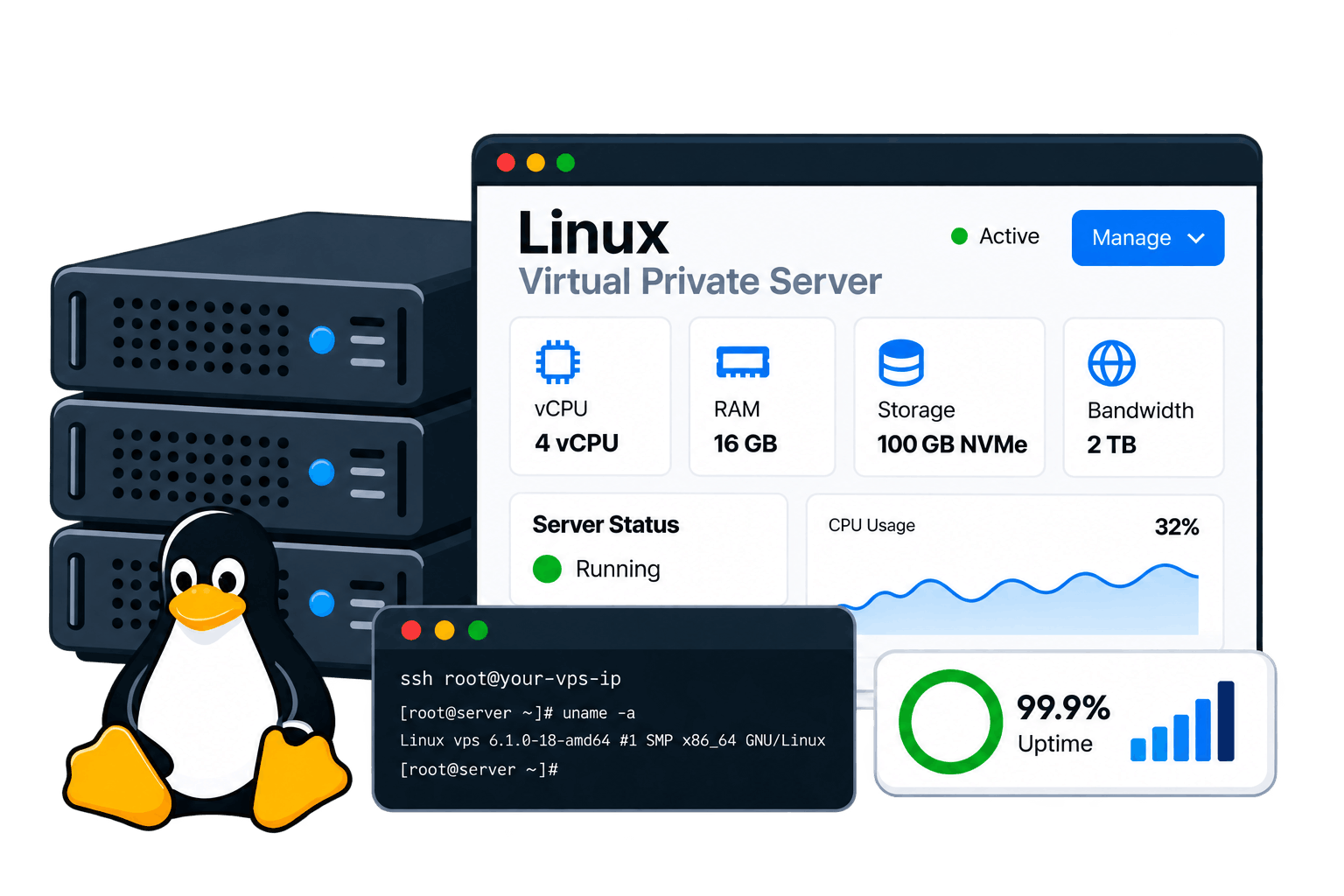
Linux VPS Plans & Pricing in Sri Lanka
Buy Linux VPS hosting for business in Sri Lanka . Our Linux VPS plans include dedicated vCPU and RAM resources, fast NVMe SSD storage, full root access via SSH, and managed or unmanaged support for business workloads. Review the plans & pricing below and choose the configuration that best fits your applications and future growth.
LBC-4.16
| vCPU | 4 vCPU |
| Memory | 16 GB |
| Storage | 100 GB SSD NVMe |
| Network | 1 Gbps |
| Bandwidth | Unmetered |
| SSH Access | Yes |
| IP Address | Dedicated |
| OS | Linux |
Starting from
LKR11,613
/moLBC-16.32
| vCPU | 16 vCPU |
| Memory | 32 GB |
| Storage | 950 GB SSD NVMe |
| Network | 1 Gbps |
| Bandwidth | Unmetered |
| SSH Access | Yes |
| IP Address | Dedicated |
| OS | Linux |
Starting from
LKR35,510
/moLBC-16.64
| vCPU | 16 vCPU |
| Memory | 64 GB |
| Storage | 2 TB SSD NVMe |
| Network | 1 Gbps |
| Bandwidth | Unmetered |
| SSH Access | Yes |
| IP Address | Dedicated |
| OS | Linux |
Starting from
LKR62,310
/moLBC-8.16
| vCPU | 8 vCPU |
| Memory | 16 GB |
| Storage | 500 GB SSD NVMe |
| Network | 1 Gbps |
| Bandwidth | Unmetered |
| SSH Access | Yes |
| IP Address | Dedicated |
| OS | Linux |
Starting from
LKR19,430
/moLBC-8.32
| vCPU | 8 vCPU |
| Memory | 32 GB |
| Storage | 500 GB SSD NVMe |
| Network | 1 Gbps |
| Bandwidth | Unmetered |
| SSH Access | Yes |
| IP Address | Dedicated |
| OS | Linux |
Starting from
LKR25,460
/moLinux VPS features
Every Linux VPS server on Qpeck ships with the same infrastructure standard, regardless of plan size — these are the building blocks behind all our Linux VPS solutions.
KVM virtualization
Full hardware virtualization gives your Linux VPS its own isolated kernel.
NVMe SSD storage
All-flash SSD storage on every plan for consistently low read and write latency.
Root access & SSH
Full administrative control, connected over SSH with your own key pair.
IPv4 & IPv6
A dedicated IPv4 address plus a full IPv6 allocation, included on every plan.
Snapshots
Capture your Linux virtual server's state before a risky change and roll back in a click.
Scalable resources
Resize vCPU, RAM, and storage on the same Linux cloud VPS instance as you grow.
API access
Provision and manage your Linux VPS server programmatically.
24/7 support
Real engineers available around the clock for both managed and unmanaged Linux VPS plans.
Supported Linux distributions
All five distributions run on every Linux VPS plan — switch at checkout, or reinstall later from your dashboard.
Ubuntu
The most widely used Linux distribution, with broad software support and frequent updates.
Best for: general hosting, Docker, dev environments
Debian
A stability-first distribution favored for long-term, low-maintenance deployments.
Best for: production servers, long-term stability
AlmaLinux
A free, RHEL-compatible distribution built as a long-term CentOS replacement.
Best for: enterprise workloads, cPanel hosting
Rocky Linux
Another RHEL-compatible distribution, built by the community for enterprise reliability.
Best for: enterprise apps, regulated environments
CentOS Stream
The continuation of the CentOS project, tracking just ahead of Red Hat Enterprise Linux.
Best for: teams that want to test against upcoming RHEL changes
Which Linux distribution should you choose?
If you're not sure where to start, this is usually enough to decide.
| If you want… | Choose | Why |
|---|---|---|
| The most documentation and community support | Ubuntu | Largest user base, broadest package availability |
| Maximum long-term stability | Debian | Conservative release cycle, minimal surprises |
| An enterprise-grade, RHEL-compatible base | AlmaLinux | Free, binary-compatible with Red Hat Enterprise Linux |
| A community-governed RHEL alternative | Rocky Linux | Built specifically as a long-term CentOS successor |
| To track upcoming RHEL changes closely | CentOS Stream | Rolling preview of what lands in RHEL next |
Why choose Linux VPS?
A Linux VPS server gives you the openness of Linux with the dedicated resources of a proper virtual private server — no licensing fees, no unnecessary overhead.
No licensing cost
Every distribution we offer is free and open-source, keeping your Linux VPS pricing predictable.
Lightweight & efficient
A lower baseline resource footprint than Windows means more capacity for your actual application.
Root access & SSH
Full command-line control over SSH, scriptable and automatable from the moment it deploys.
Built for developers
PHP, Node.js, Python, and Docker all target Linux first — a Linux VPS for developers just fits.
Proven security model
A widely audited kernel and mature permissions model, hardened further with SSH key authentication.
Ready for business
From a single site to an enterprise Linux VPS deployment, the same platform scales with you.
Popular Applications for Linux VPS
Deploy popular Linux applications in minutes with full root access and complete control. Whether you're hosting websites, running eCommerce stores, building SaaS platforms, or managing private cloud storage, Qpeck Linux VPS provides the performance and flexibility to support production workloads.
WordPress
The web's most popular CMS
WooCommerce
eCommerce built on WordPress
Nextcloud
Self-hosted file sync & sharing
Docker
Containers & Microservices
GitLab
DevOps & CI/CD
PostgreSQL
Enterprise Databases
Plus everything a modern developer stack needs, ready to install:
Common Linux VPS use cases
If a workload needs consistent resources and real configuration control, a Linux VPS server is usually the right fit for you.
Website hosting
Application hosting
Database servers
Dev & staging environments
Email servers
VPN & proxy servers
Linux VPS vs. other hosting solutions
Here's how a Linux VPS server stacks up against the other hosting options you're likely comparing it to.
| Feature | Shared Hosting | Linux VPS | Windows VPS | Bare Metal |
|---|---|---|---|---|
| Root access | No | Yes | Yes | Yes |
| Resource allocation | Shared, oversold | Dedicated per VM | Dedicated per VM | Entire physical server |
| Licensing cost | None | None | Included, priced in | Depends on OS chosen |
| Best for | Small brochure sites | Developers, apps, Linux VPS for business | .NET & Microsoft-stack apps | Maximum, dedicated performance |
Why choose Qpeck Linux VPS?
Plenty of Linux VPS providers sell virtual machines — the difference shows up in what happens after checkout.
Real dedicated resources
Your vCPU and RAM allocations are reserved, not oversold across tenants — as a Linux VPS hosting provider, we don't cut corners here.
All-NVMe infrastructure
Every plan runs on NVMe SSD storage by default, no legacy spinning disks.
Any distribution included
Ubuntu, Debian, AlmaLinux, Rocky Linux, or CentOS Stream — no extra cost, no separate SKU.
Managed & unmanaged options
Full control on unmanaged Linux VPS, or full support on managed Linux VPS — your call.
24/7 technical support
Real engineers, available around the clock, for provisioning and server-level issues.
Resize without migrating
Scale vCPU, RAM, and storage on the same Linux VPS server as your workload grows.
How Linux VPS works
A hypervisor sits between the physical hardware and every virtual private server, dividing resources and enforcing isolation — so your Linux VPS behaves like a standalone machine.
Physical hardware
A dedicated physical server provides the underlying CPU, RAM, and NVMe SSD storage.
KVM hypervisor
KVM virtualization carves the host into isolated virtual private servers, each with reserved resources.
Your Linux VPS
An isolated environment with its own kernel, distribution, and guaranteed slice of CPU and memory.
Root access to you
You manage your Linux virtual server exactly like a standalone box — install, configure, reboot at will.
Your Linux VPS runs on isolated KVM virtualization — a full, independent kernel, with no shared tenancy.
Security & network
Isolation at the hypervisor level is the foundation — every Linux VPS ships with additional protection built in.
DDoS protection
Volumetric attacks are filtered upstream before they ever reach your Linux VPS server.
Configurable firewall
Manage inbound and outbound rules at the OS level or through your control panel.
SSH key authentication
Disable password login entirely and connect using key-based authentication only.
Dedicated IPv4 & IPv6
A dedicated public IPv4 address plus a full IPv6 allocation on every Linux virtual server.
Private networking
Connect multiple Linux VPS instances over an internal network, isolated from the public internet.
Resource monitoring
Dashboard alerts flag unusual CPU, memory, or traffic patterns early.
Frequently Asked Questions
Linux VPS hosting provides a virtual private server running a Linux operating system with dedicated CPU and RAM resources, NVMe SSD storage, and full root access. It gives businesses and developers greater control, flexibility, and performance than traditional shared hosting.
Linux VPS and Linux VPS server generally refer to the same type of hosting service. Both provide a virtual private server running Linux with allocated resources, root access, and the flexibility to configure your server environment.
you can buy Linux VPS hosting from Qpeck for your business in Sri Lanka. Choose a plan based on your CPU, RAM, NVMe storage, bandwidth, and support requirements, select your preferred Linux configuration, and complete your order online.
Choose a plan based on your application requirements and expected traffic. Consider the amount of CPU, RAM, NVMe storage, and bandwidth your workloads need, along with whether you require managed or unmanaged support.
Yes. Linux VPS hosting is suitable for business websites, web applications, databases, APIs, development environments, and other workloads that require dedicated resources and greater server control.
es. A Linux VPS provides full root and SSH access, allowing developers to install software, configure services, deploy applications, manage databases, and customize the server environment.
Yes. Qpeck Linux VPS plans provide full root access through SSH, giving you control over server configuration, software installation, security settings, and system administration.
Qpeck offers Linux VPS configurations at different resource levels, allowing you to select a plan based on your performance and budget requirements without paying for resources you do not need.
Yes. You can scale your Linux VPS resources as your requirements increase. Upgrading CPU, RAM, storage, or other resources can help accommodate growing applications, websites, and workloads.
Compare providers based on CPU and RAM allocation, storage technology, network reliability, root and SSH access, security features, uptime, support options, scalability, and pricing. These factors help determine whether a Linux VPS is suitable for your workload.
For businesses in Sri Lanka, Linux VPS hosting starts from LKR11,613/month for affordable Linux VPS configurations. Pricing varies based on CPU, RAM, NVMe storage, bandwidth, and support requirements. Qpeck also offers low-cost Linux VPS plans for different workloads, allowing you to choose a configuration that fits your requirements and budget.
Yes. Qpeck offers cheap Linux VPS hosting starting from LKR11,613/month for businesses in Singapore, with configurations suitable for websites, applications, development environments, and other workloads.