
VPS Hosting
Virtual Private Server for Businesses in Singapore
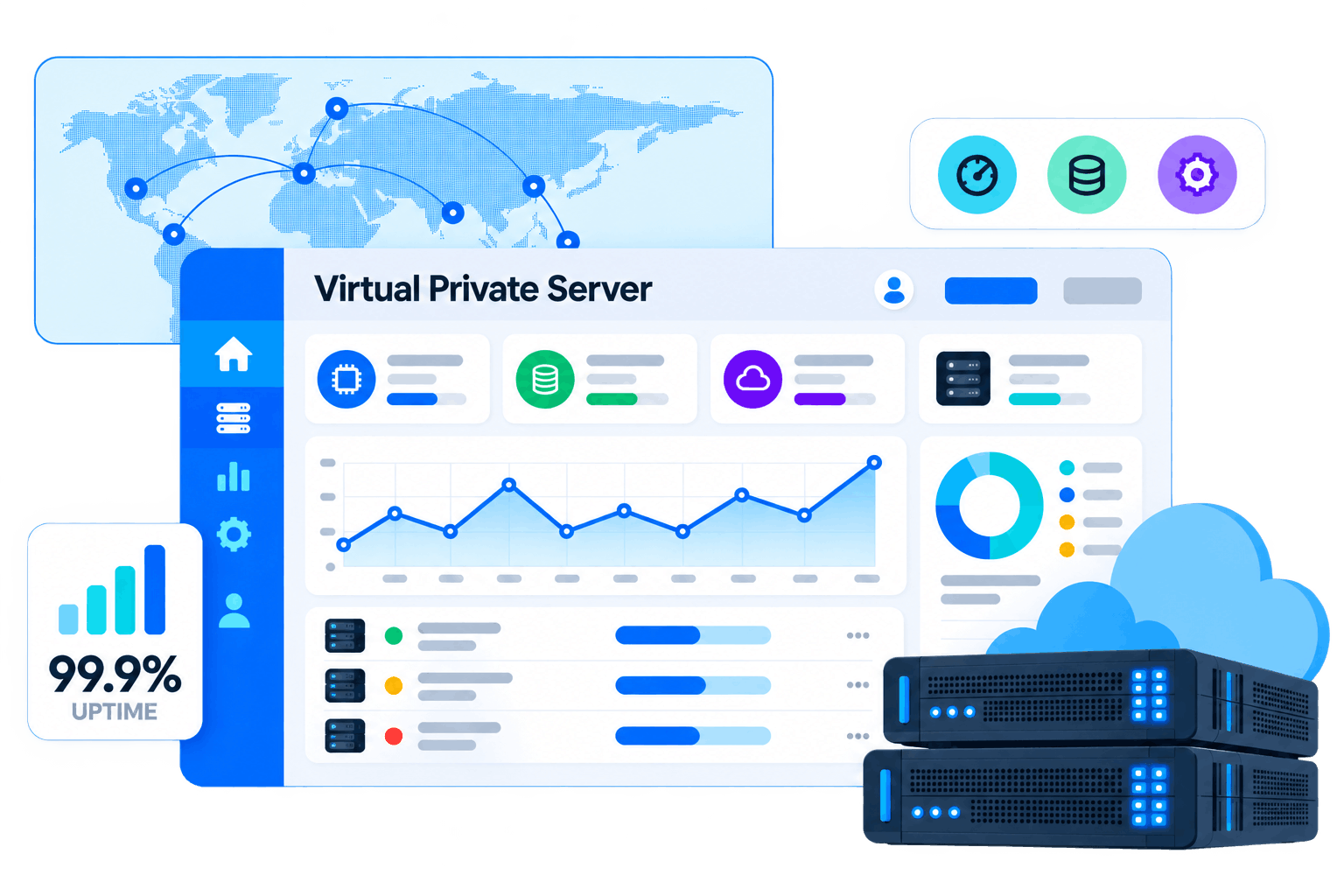
Enterprise-grade Virtual Private Server infrastructure, engineered for scale. Run production workloads on isolated virtual machines with dedicated vCPU, RAM, and NVMe storage — backed by a 99.9% uptime SLA, redundant architecture, and zero-downtime provisioning. Complete root-level control. Infrastructure that scales with you, on demand.
- Full SSH Access
- NVMe storage
- 99.9% Uptime SLA
- DDoS protection
- Zero noisy-neighbor impact
VPS Hosting Price
Buy VPS server for business in Singapore by comparing dedicated resources, performance, and pricing. Our VPS hosting plan includes enterprise-ready KVM virtualization, dedicated vCPU, RAM, and NVMe storage for reliable production workloads.
LBC-4.16
| vCPU | 4 vCPU |
| Memory | 16 GB |
| Storage | 100 GB SSD NVMe |
| Network | 1 Gbps |
| Bandwidth | Unmetered |
| OS | Linux |
Starting from
S$44.72
/moLBC-16.32
| vCPU | 16 vCPU |
| Memory | 32 GB |
| Storage | 950 GB SSD NVMe |
| Network | 1 Gbps |
| Bandwidth | Unmetered |
| OS | Linux |
Starting from
S$136.74
/moLBC-16.64
| vCPU | 16 vCPU |
| Memory | 64 GB |
| Storage | 2 TB SSD NVMe |
| Network | 1 Gbps |
| Bandwidth | Unmetered |
| OS | Linux |
Starting from
S$239.94
/moLBC-8.16
| vCPU | 8 vCPU |
| Memory | 16 GB |
| Storage | 500 GB SSD NVMe |
| Network | 1 Gbps |
| Bandwidth | Unmetered |
| OS | Linux |
Starting from
S$74.82
/moLBC-8.32
| vCPU | 8 vCPU |
| Memory | 32 GB |
| Storage | 500 GB SSD NVMe |
| Network | 1 Gbps |
| Bandwidth | Unmetered |
| OS | Linux |
Starting from
S$98.04
/moWCC-16.32
| vCPU | 16 vCPU |
| Memory | 64 GB |
| Storage | 950 GB SSD NVMe |
| Network | 1 Gbps |
| Bandwidth | Unmetered |
| OS | Linux |
Starting from
S$330.24
/moWCB-4.16
| vCPU | 4 vCPU |
| Memory | 16 GB |
| Storage | 250 GB SSD NVMe |
| Network | 1 Gbps |
| Bandwidth | Unmetered |
| OS | Linux |
Starting from
S$82.56
/moWCM-8.32
| vCPU | 8 vCPU |
| Memory | 32 GB |
| Storage | 500 GB SSD NVMe |
| Network | 1 Gbps |
| Bandwidth | Unmetered |
| OS | Linux |
Starting from
S$154.80
/moWCS-8.32
| vCPU | 8 vCPU |
| Memory | 32 GB |
| Storage | 950 GB SSD NVMe |
| Network | 1 Gbps |
| Bandwidth | Unmetered |
| OS | Linux |
Starting from
S$255.42
/moWhat is a Virtual Private Server?
A Virtual Private Server is a virtual machine created on a physical server using virtualization technology. Each VPS operates in an isolated environment with its own dedicated vCPU, RAM, storage, operating system, and administrative access, providing greater performance, security, and control than shared hosting.
Dedicated, not shared
Your vCPU and RAM allocations are reserved for you — no competing with noisy neighbors for resources.
Full root / administrator access
Install anything, configure the kernel-level settings you need, and run software shared hosting won't allow.
Priced below a dedicated server
You get most of the control of a dedicated server without paying for an entire physical machine.
Every VPS runs its own kernel and operating system, fully isolated from other virtual machines on the same host.
How does a VPS server work?
A hypervisor sits between the physical hardware and every virtual machine, dividing resources and enforcing isolation.
Physical hardware
A dedicated physical server provides the underlying CPU, RAM, storage, and network capacity.
Hypervisor layer
Software that carves the host into multiple isolated virtual machines, each with reserved resources.
Your virtual machine
An isolated environment with its own kernel, OS, and guaranteed slice of CPU and memory.
Root access to you
You manage your VPS exactly like a standalone server — install packages, edit configs, reboot at will.
VPS architecture
Each layer adds isolation and control — from shared physical hardware down to your own root-accessible operating system.
Why layering matters. Isolation happens at the hypervisor layer, so activity on one VPS — a traffic spike, a crash, a misconfiguration — can't spill into another tenant's resources.
What you control. Everything from Layer 4 up is yours: OS choice, installed software, firewall rules, and system configuration.
Physical host server
Enterprise-grade hardware: multi-core CPUs, ECC RAM, and NVMe storage arrays in redundant data centers.
Hypervisor (KVM)
Creates and manages virtual machines, enforcing strict CPU, memory, and I/O boundaries between tenants.
Virtual machine
Your reserved slice of the host — vCPU cores, RAM, and virtual disk allocated exclusively to you.
Guest operating system
A full OS install of your choosing, running its own independent kernel inside the virtual machine.
Your applications
Web servers, databases, and custom software running exactly as they would on bare metal.
Qpeck VPS Hosting Benefits
A practical middle ground between the limits of shared hosting and the cost of a dedicated server.
Guaranteed dedicated resources
Your vCPU and RAM are reserved — no sharing capacity with other accounts on the host.
Full root access
Install any software stack, tune kernel parameters, and configure the server exactly how you need.
Scales without migration
Upgrade vCPU, RAM, or storage on the same VPS as traffic grows, instead of moving to new infrastructure.
Cost-efficient vs. dedicated
Get most of the control of a dedicated server without paying for an entire physical machine.
Isolation & security
Your own kernel and file system, separated from every other virtual machine on the host.
Predictable performance
Reserved resources mean consistent response times, even when neighboring VMs are under load.
Use cases
If a workload needs consistent resources and real configuration control, a VPS is usually the right fit.
Website hosting
Application hosting
Game servers
Dev & staging environments
Email servers
VPN & proxy servers
Supported Operating systems on VPS
Deploy your VPS with the OS your stack already depends on — swap or reinstall anytime from your dashboard.
Ubuntu
Debian
AlmaLinux / Rocky
CentOS Stream
Windows Server
FreeBSD
Managed VPS vs. unmanaged VPS
Both run on identical hardware — the difference is who handles the server administration.
Managed VPS
- We handle OS updates, security patching, and monitoring
- Support helps with server-level troubleshooting
- Best if you'd rather focus on your application, not the OS
Unmanaged VPS
- You handle updates, hardening, and configuration
- Support covers the network and hypervisor, not your OS
- Best if you want full control and already run servers
Which one should you choose? If you don't have the time or team to patch and monitor a server yourself, managed is worth the premium. If you're comfortable on the command line and want maximum control, unmanaged costs less for the same hardware.
Virtualization technologies
Not all "VPS" is built the same way — the virtualization type affects isolation, performance, and flexibility.
KVM (Kernel-based VM)
Full hardware virtualization — each VPS runs its own independent kernel, fully isolated from the host and other guests. Qpeck runs KVM by default.
Xen
A mature hypervisor offering strong isolation via paravirtualization or full virtualization, widely used by large-scale cloud providers.
Containers (OpenVZ / LXC)
Lighter-weight isolation sharing the host's kernel — faster to spin up, but with less separation than full virtualization.
Hardware explained
Every Virtual Private Server maps to a real, reserved slice of physical hardware — here's what each spec means.
vCPU cores
A dedicated share of physical CPU cores, reserved for your VPS rather than pooled across tenants.
RAM
Guaranteed memory allocation — not a burstable limit that disappears under host-wide load.
NVMe storage
Solid-state storage over the NVMe interface, dramatically faster than traditional SATA SSDs
Network uplink
Redundant network connections with generous monthly bandwidth allowances per plan.
Performance
Reserved resources plus NVMe storage translate into consistent, predictable performance — not just peak-hour benchmarks.
100%
Dedicated vCPU allocation
~1-4 Hours
Typical deployment time
NVMe
All-flash storage tier
99.9%
Network uptime SLA
Security in-built on VPS
Isolation at the hypervisor level is only the first layer — every VPS ships with additional protection built in.
Network-level DDoS protection
Volumetric attacks are filtered upstream before they reach your VPS.
Configurable firewall
Manage inbound and outbound rules at the OS level or through your control panel.
Isolated kernel per VPS
Full KVM virtualization means no shared kernel vulnerabilities across tenants.
Automated backups & snapshots
Point-in-time snapshots let you roll back quickly if something goes wrong.
SSH key authentication
Disable password login entirely and connect using key-based authentication.
Resource & anomaly monitoring
Dashboard alerts flag unusual CPU, memory, or traffic patterns early.
Networking
Every plan includes the networking basics, larger plans add private networking and additional IPs.
Dedicated IPv4
A dedicated public IP address included with every VPS plan.
IPv6 support
A full IPv6 allocation available alongside your IPv4 address at no extra cost.
Private networking
Connect multiple VPS instances over an internal network, isolated from the public internet.
DNS management
Manage DNS records for your domains directly from the same dashboard as your VPS.
Storage
Every VPS includes fast NVMe SSD storage, with larger plans providing additional capacity for demanding workloads.
NVMe SSD storage
All primary storage runs on NVMe drives for consistently low read/write latency.
RAID-protected arrays
Host storage is RAID-configured so a single drive failure doesn't mean data loss.
On-demand snapshots
Capture your VPS state before a risky change and restore it in a few clicks.
Add-on block storage
Attach extra NVMe volumes independently of your VPS plan as your storage needs grow.
Control panels
Add a graphical control panel at checkout, or skip it entirely and manage everything from the command line.
cPanel / WHM
Popular, feature-rich
Plesk
Multi-OS friendly
Webmin
Free, open-source
CLI only
No panel overhead
Developer tools
A VPS from Qpeck behaves like any other Linux or Windows box in your toolchain — because it is one.
SSH root access
Connect directly with your own key pair from day one.
API access
Provision, resize, and manage VPS instances programmatically.
Docker-ready
Run containers on top of your VPS just like on any standard Linux host.
One-click app installer
Deploy common stacks — WordPress, Node.js, LAMP — without manual setup.
Git & CI/CD friendly
Deploy from your existing pipelines exactly as you would to any remote server.
Comparison tables
VPS provides more isolation and control than shared hosting, while typically costing less than a dedicated server.
| Feature | Shared Hosting | VPS | Dedicated Server | Cloud Instance |
|---|---|---|---|---|
| Resource allocation | Shared, oversold | Dedicated per VM | Entire physical server | Dedicated, elastic |
| Root / admin access | No | Yes | Yes | Yes |
| Scalability | Very limited | Resize on the same VM | Requires new hardware | Instant, elastic |
| Isolation | Minimal | Full (own kernel) | Complete | Full (own kernel) |
| Best for | Small brochure sites | Apps, sites, dev environments | Maximum-performance workloads | Variable, bursty traffic |
Migration guide
Moving to Qpeck VPS doesn't have to mean downtime — here's how a typical migration runs.
Submit a migration request
Tell us your current host and what needs to move — sites, databases, mail, or all three.
We assess your source server
Our team reviews your current setup to plan a compatible target configuration.
Data is transferred
Files, databases, and configurations are copied to your new VPS in the background.
DNS cutover
Once verified, DNS is pointed to your new VPS with minimal propagation delay.
You're live on Qpeck
We monitor the first 24 hours and keep your old server available as a fallback.
Why buy VPS from Qpeck?
Plenty of providers sell VPS hardware — the difference shows up in what happens after checkout.
Real dedicated resources
Your vCPU and RAM allocations are reserved, not oversold across multiple tenants.
All-NVMe infrastructure
Every plan runs on NVMe storage by default — no legacy spinning disks or SATA SSD tiers.
Free migration assistance
Our team helps move sites, databases, and mail from your current host at no extra charge.
Managed & unmanaged options
Choose full administrative control or let our team handle patching and monitoring — your call.
24/7 technical support
Real engineers, available around the clock, for provisioning, networking, and server issues.
Resize without migrating
Scale vCPU, RAM, and storage on the same VPS as your workload grows — no re-platforming required.
Frequently Asked Questions
VPS means Virtual Private Server. VPS hosting uses virtualization to create an isolated virtual server on physical infrastructure. Each virtual server has its own allocated CPU, RAM and storage, giving you more control and resources than traditional shared hosting.
In simple terms, virtual private hosting provides a private virtual environment where you can install applications, configure services and manage your server according to your requirements.
A virtual server is a software-defined server created on physical server infrastructure using virtualization. Virtual server hosting allows multiple isolated virtual servers to operate on the same physical machine while keeping their resources and environments separated.
A VPS is one common form of virtual server hosting that gives customers server-level control and allocated resources.
When choosing a VPS provider in Singapore, consider more than the VPS price. Check the server location, CPU and RAM allocation, storage technology, network performance, security, support and upgrade options.
Qpeck provides VPS hosting for businesses and websites serving users in Singapore with NVMe storage, dedicated resource allocations, full root access, DDoS protection and 24/7 support.
The VPS hosting price depends on the CPU, RAM, storage and other resources included in the selected configuration. At Qpeck, VPS hosting starts at S$44.72 per month.
When comparing VPS cost, look at the resources and infrastructure included in each plan rather than comparing the monthly price alone.
You can buy VPS hosting from Qpeck by selecting a suitable plan, choosing the required resources and completing your order online.
If you are ready to buy a VPS server, you can compare the available configurations and select the plan that best matches your website, application or business workload.
A Qpeck VPS server provides allocated CPU, RAM and NVMe storage along with full root access. VPS plans also include DDoS protection and 24/7 support.
The available resources vary by plan, so you can choose a configuration based on the requirements of your application or website.
Yes. VPS web hosting is suitable for websites that have outgrown shared hosting or need more control over their hosting environment.
With VPS website hosting, you can configure the server for your specific application, install required software and manage server-level settings. This makes VPS hosting useful for business websites, e-commerce stores, web applications and other resource-intensive websites.
Yes. A VPS for website hosting can run one or multiple websites, depending on the available CPU, RAM, storage and bandwidth.
VPS hosting gives you more control than shared hosting and allows you to configure the server environment according to your website's requirements. It can be particularly useful for growing websites that need dedicated resource allocations.
VPS web hosting services can be used for business websites, e-commerce platforms, APIs, databases, web applications and development environments.
Because you have control over the server environment, you can install and configure the software required by your application instead of being limited to the setup provided by standard shared hosting.
A good VPS hosting plan should provide the right balance of performance, resources, security, reliability and cost.
Look at the CPU and RAM allocation, storage technology, network connectivity, server location, DDoS protection, root access, support and available upgrade options. The best VPS for web hosting depends on your website's actual resource requirements rather than simply choosing the cheapest plan.
Shared hosting places multiple websites within a shared hosting environment, while VPS hosting provides an isolated virtual server with allocated resources and greater control.
If your website needs more resources, customization or server-level access, VPS web hosting can provide a more flexible environment than a shared server.
Yes. You can use one VPS server for hosting multiple websites and domains, provided the available CPU, RAM, storage and bandwidth are sufficient for the combined workload.
This makes VPS hosting useful for businesses, developers and agencies managing several websites or applications from one server.
Qpeck provides VPS hosting for customers serving users in Singapore through its available data center infrastructure.
If your website or application primarily serves users in Singapore, consider the physical location of the selected server when choosing a VPS, as server location can affect network latency.
A virtual private server can host business websites, e-commerce stores, web applications, APIs, databases, development environments and other applications that require an isolated server environment.
You can configure the server according to your workload because VPS hosting provides much greater control than conventional shared hosting.
An affordable VPS can be a practical starting point when your business needs more control and resources than shared hosting provides.
Rather than choosing a VPS solely because it is inexpensive, compare the CPU, RAM, NVMe storage, network, security and support included in the plan. The right affordable VPS server should provide enough resources for your current workload while allowing you to upgrade as your requirements grow.
Start by estimating your CPU, RAM, storage and bandwidth requirements. Then compare the VPS server price, resource allocation, storage technology, server location, security features, support and upgrade options.
For businesses serving users in Singapore, consider the server location, network connectivity and available resources when selecting a VPS. Choose a configuration that meets your current workload and provides enough room to scale.